Tuesday 24 November, 18:30

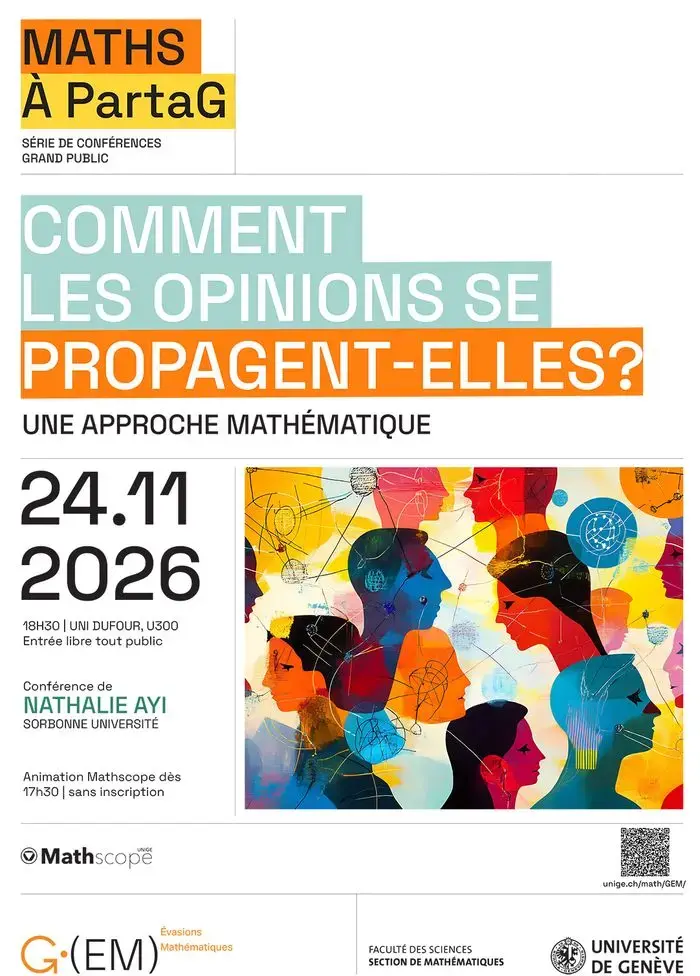
How Do Opinions Spread?

Mathematician Nathalie Ayi of Sorbonne Université explores how mathematical models can help explain the spread of opinions within a population. Her research sheds light on the mechanisms that drive collective behaviour, from consensus to polarisation.

In this public lecture, she examines how conversations, social networks, and everyday interactions shape changing viewpoints. The session discusses why these dynamics matter and how mathematics can reveal patterns that are difficult to observe directly. No prior mathematical knowledge is required.
Rue du Général-Dufour 24,
1204 Genève
Photo Credit: UNIGE
{"title":"How Do Opinions Spread?","description":"\u003Cp\u003EMathematician Nathalie Ayi of Sorbonne Universit\u00e9 explores how mathematical models can help explain the spread of opinions within a population. Her research sheds light on the mechanisms that drive collective behaviour, from consensus to polarisation.\u003C\/p\u003E\u003Cp\u003EIn this public lecture, she examines how conversations, social networks, and everyday interactions shape changing viewpoints. The session discusses why these dynamics matter and how mathematics can reveal patterns that are difficult to observe directly. No prior mathematical knowledge is required.\u003C\/p\u003E","start_date":"2026-11-24","end_date":"2026-11-24","date":"Tuesday 24 November, 18:30","timings":[{"timing_start_date":"20261124T173000Z","timing_end_date":"20261124T183000Z"}]}
Photo Credit: UNIGE

You might also like

22 September – 15 December

The Department of Ancient Studies at the Faculty of Humanities (UNIGE) is offering a series of public lectures dedicated to interactions, exchanges, and cultural dynamics in the ancient world. Faculty members and researchers will explore diplomatic relations, the movement of objects, religious and linguistic influences, and issues of identity at the crossroads of the Mediterranean and the ancient Near East.

In French.

Monday 23 November, 18:30

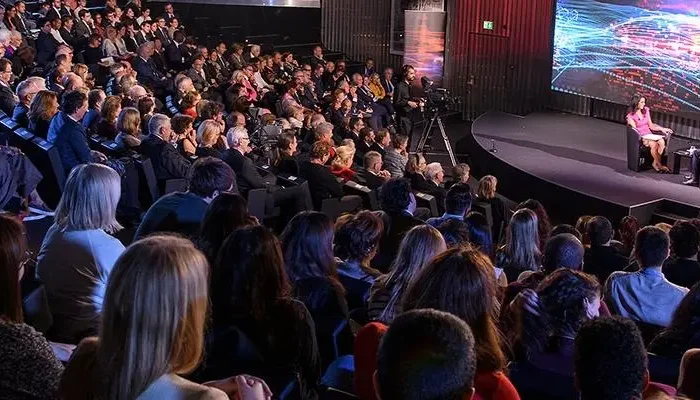
This lecture explores how Ukraine and the lands north of the Black Sea have shaped major global historical developments, from prehistory to the present. It examines how Ukrainian history can reshape familiar narratives of world history by placing the region at the center of wider political, cultural, and intellectual transformations. The keynote is delivered by Timothy Snyder, followed by a conversation with Awet Weldemichael and a public question-and-answer session, with a welcome by Marie-Laure Salles.

In English.

Tuesday 24 November, 14:30

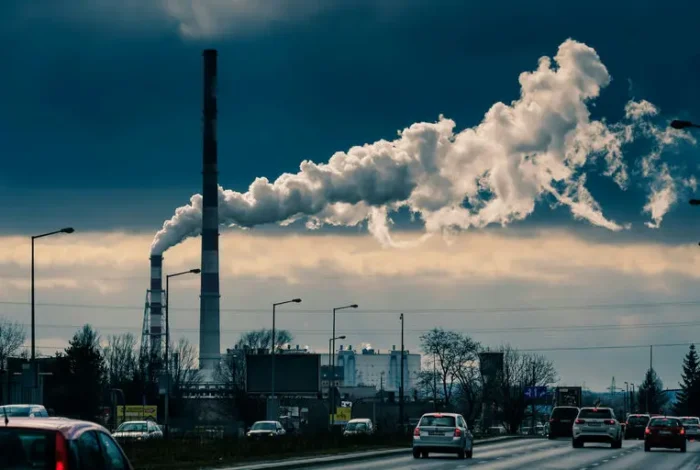
Living in a healthy environment is a core concern for Geneva residents. Air pollutants can have significant public health impacts. This lecture presents the canton’s strategy to improve air quality, examines current trends and monitoring practices, and discusses future measures for mitigation and policy. Participants will gain an understanding of key pollutants, health effects, regulatory approaches and prospective actions to reduce exposure and improve urban air management.

In French.

Tuesday 24 November, 12:30

François de Saint-Chéron, a literature PhD and associate professor at the Sorbonne, brings decades of research on André Malraux and has edited and curated major Malraux publications and exhibitions. Drawing on unpublished testimonies and rare accounts, he examines the life and work of the author of La Condition humaine to reveal a nuanced portrait beyond glamour and controversy, focusing on literary, political and artistic dimensions of Malraux’s career.

In French.

Tuesday 24 November, 18:30

Pierre Hazan, former diplomatic correspondent and specialist in international justice and humanitarian action for Libération and Le Temps, presents a personal and political account tracing two centuries of coexistence between Jews and Arabs through his family’s history. Mixing individual trajectories with key moments in the Middle East—from Jerusalem to Egypt—Hazan examines cultural and political hybridization, revolutionary commitments and wartime ruptures, arguing that daily judeo‑Arab coexistence was once a lived reality and should remain a horizon.

In French.

Tuesday 24 November, 18:30

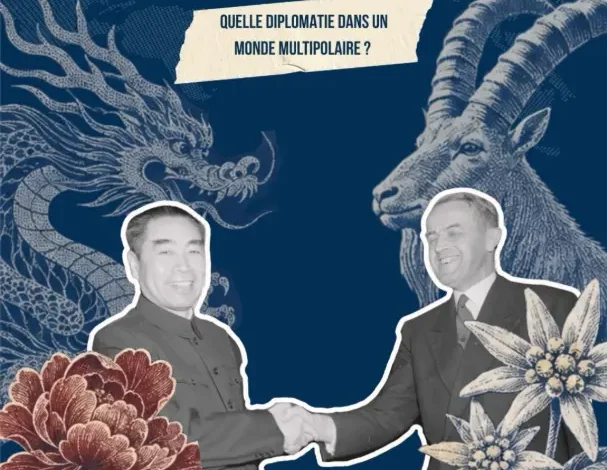
The SDSA Conferences Department is pleased to host a panel discussion exploring Swiss–Chinese relations and the future of this partnership in an evolving international context. From Switzerland’s early recognition of the People’s Republic of China in 1950 to the 2013 Free Trade Agreement, bilateral relations have developed across trade, scientific cooperation and political dialogue. Today, amid China’s growing global influence and rising geopolitical tensions, Switzerland faces the challenge of balancing economic interests, values and its diplomatic tradition. How can Switzerland maintain constructive dialogue with Beijing while safeguarding its autonomy?

Speakers:
– Prof. Basile Zimmermann (UNIGE)
– Prof. Jan Kiely (IHEID)
– Mr. Béroud, Founder of Sinoptic
– Mr. Bideau, Head of Communications at the FDFA

Sciences II, Room A150 – University of Geneva (UNIGE)

Oops! It seems there
are no events matching your selection!

Please adjust your criteria to see more results.

Password was reset

Your password has been reset successfully. You can now log in with your new password.

Check your Inbox

We’ve sent you a password reset email to the address provided. Please check your inbox and/or spam folder.

Thank you!

Please check your inbox for a verification email to complete your sign-up.

Newsletter

Culture, curated weekly.

Add to Calendar

Select the date to be saved in your Google calendar.

calendar placeholder

Done!

Event removed from your CoolAgenda.

Yeah!

Event Saved to your CoolAgenda

Add to CoolAgenda

In your CoolAgenda

Date

Title

Location

Description

calendar placeholder

Reset password

Forgot your password?

Sign Up

Create your Account and Culture Up!