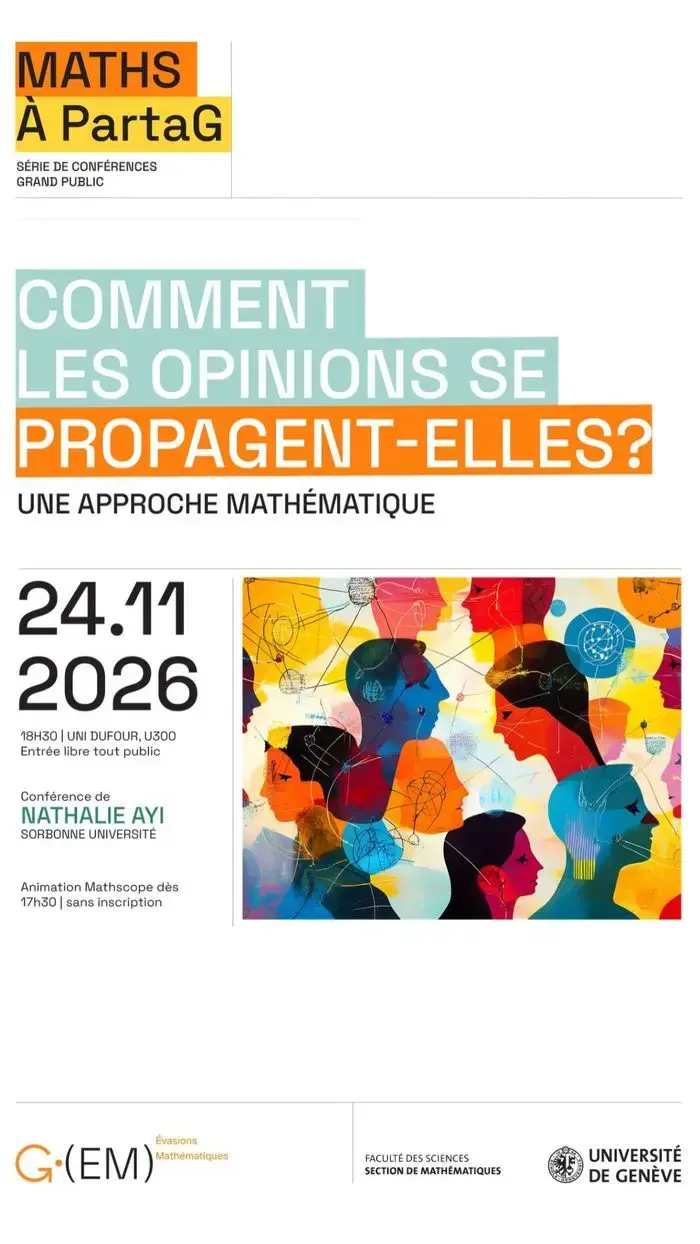
Tuesday 24 November, 18:30

How Do Opinions Spread?

Nathalie Ayi explores how social interactions shape collective thinking, from consensus to polarization. Her talk draws on mathematical tools to examine opinion dynamics across groups and the mechanisms that influence how ideas circulate.

She investigates graph theory and equations to model the evolution of opinions within a population, showing how these frameworks can help explain large-scale phenomena such as consensus formation and polarization.

In French.
Rue du Général-Dufour 24,
1204 Genève
Photo Credit: unige.ch/math/GEM/
{"title":"How Do Opinions Spread?","description":"\u003Cp\u003ENathalie Ayi explores how social interactions shape collective thinking, from consensus to polarization. Her talk draws on mathematical tools to examine opinion dynamics across groups and the mechanisms that influence how ideas circulate.\u003C\/p\u003E\u003Cp\u003EShe investigates graph theory and equations to model the evolution of opinions within a population, showing how these frameworks can help explain large-scale phenomena such as consensus formation and polarization.\u003C\/p\u003E\u003Cp\u003E\u003Cstrong\u003EIn French.\u003C\/strong\u003E\u003C\/p\u003E","start_date":"2026-11-24","end_date":"2026-11-24","date":"Tuesday 24 November, 18:30","timings":[{"timing_start_date":"20261124T173000Z","timing_end_date":"20261124T183000Z"}]}
Photo Credit: unige.ch/math/GEM/

You might also like

16 September – 10 December

Cyril Dériaz holds a master’s degree in literary writing from the Bern University of the Arts and has led writing workshops for one year.

The workshops explore narrative techniques, imaginative prompts and perspective shifts, combining guided exercises, collective feedback and iterative rewriting to develop stories, poems and longer forms. Dériaz examines beginnings, plot moments and endings while prompting experiments with voice and form to strengthen individual practice and creative confidence.

In French.

22 September – 15 December

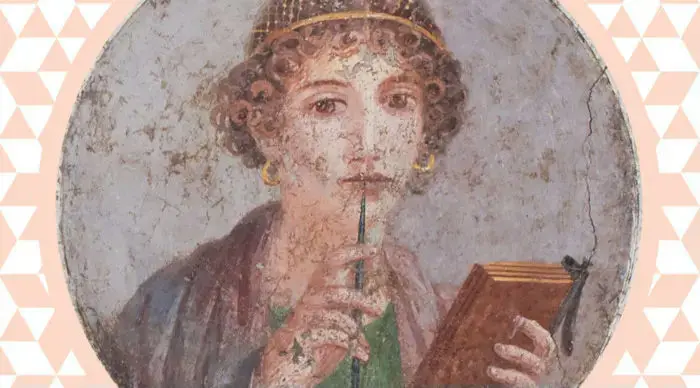
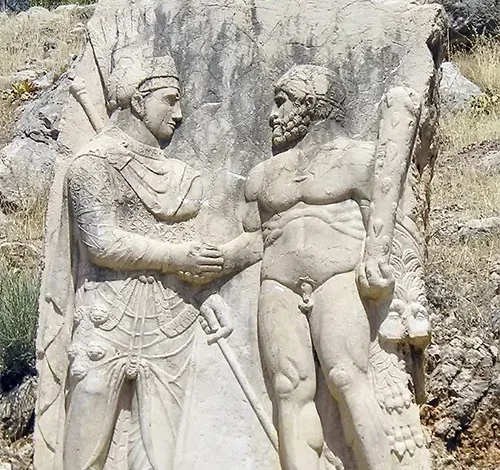
The Department of Ancient Studies at the Faculty of Humanities (UNIGE) is offering a series of public lectures dedicated to interactions, exchanges, and cultural dynamics in the ancient world. Faculty members and researchers will explore diplomatic relations, the movement of objects, religious and linguistic influences, and issues of identity at the crossroads of the Mediterranean and the ancient Near East.

In French.

Wednesday 28 October, 21:00

Footnotes is a Geneva-based journal devoted to typography and type design, published in English by La Police and printed in Geneva. This launch celebrates its new issue, Footnotes F, with a visual and sonic lecture by Francis Baudevin. He examines the typography of selected albums, exploring how letterforms contribute to the visual identity of music. The programme continues with a record set by Maud Pollien, bringing together sound and graphic culture.

2 – 6 November

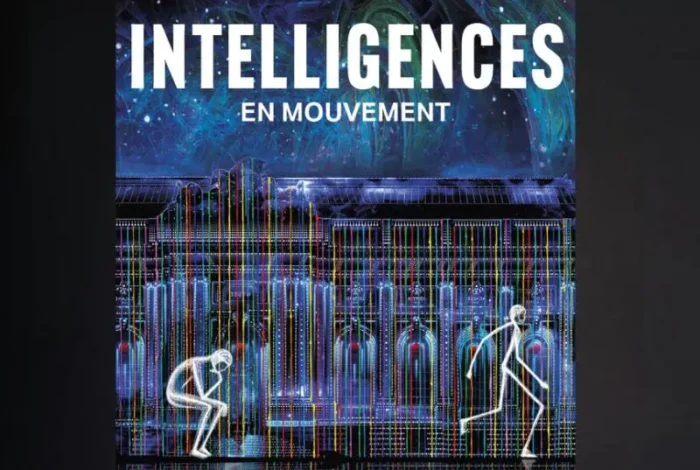
Wright Colloquium 2026 brings together interdisciplinary inquiry to rethink what we call intelligence. The program examines intelligence across scales — from artificial systems and ant colonies to neurons and engrams — and considers cognitive, neurological and philosophical perspectives. Participants will explore how different forms of intelligence shape societies, knowledge and our worldviews, with discussions, panels and workshops aimed at advancing conceptual and practical understanding.

In French and in English.

Wednesday 28 October, 19:00

Author Giles Milton, known for his bestselling narrative histories, presents an investigation of the wartime alliance between Churchill, Stalin and Roosevelt. Drawing on previously unpublished correspondence and sources, Milton examines the motivations, negotiations and personal dynamics that enabled cooperation against Nazi Germany. The talk unpacks key decisions and the human factors behind them, revealing how these leaders shaped the modern world.

In English.

28 January – 23 December

This workshop explores the traditional process of assembling a herbarium specimen, inspired by Jean-Jacques Rousseau’s collections. Participants learn scientific techniques for pressing and mounting dried plants on old paper, practice botanical labelling and nomenclature, and select specimens to create a personal herbarium sheet. The session examines preservation methods, identification principles and the historical context of Rousseau’s approach, combining practical skills with scientific insight to produce a lasting botanical object.

In French.

Oops! It seems there
are no events matching your selection!

Please adjust your criteria to see more results.

Password was reset

Your password has been reset successfully. You can now log in with your new password.

Check your Inbox

We’ve sent you a password reset email to the address provided. Please check your inbox and/or spam folder.

Thank you!

Please check your inbox for a verification email to complete your sign-up.

Newsletter

Culture, curated weekly.

Add to Calendar

Select the date to be saved in your Google calendar.

calendar placeholder

Done!

Event removed from your CoolAgenda.

Yeah!

Event Saved to your CoolAgenda

Add to CoolAgenda

In your CoolAgenda

Date

Title

Location

Description

calendar placeholder

Reset password

Forgot your password?

Sign Up

Create your Account and Culture Up!