2 February – 11 May

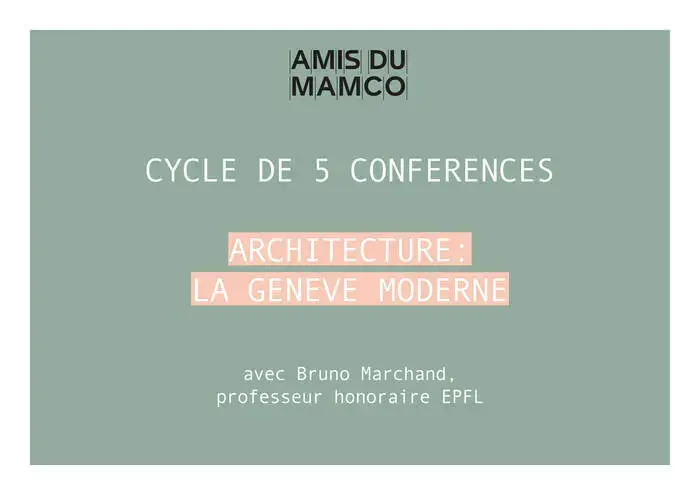
Architecture: Modern Geneva, by Bruno Marchand

Booking Required

Bruno Marchand, professor emeritus at EPFL, leads this five-part lecture series designed for newcomers to architectural history. He brings his academic experience to introduce key figures and approaches in Geneva’s twentieth-century modernity.

The course examines five monographic approaches focused on architects whose urban thinking and buildings have permanently shaped Geneva’s territory and landscape. Sessions investigate themes such as technical progress, Miesian legacy, Le Corbusier’s influence and the plastic use of concrete, revealing how modernity transformed the city.

In French.

Programme:

– Monday 2 February, 12:15: Maurice Braillard and the early foundations of Genevan modernity
– Monday 2 March, 12:15: The architecture of Marc-Joseph Saugey: technology and progress
– Monday 16 March, 12:15: The architecture of Jean-Marc Lamunière: the legacy of Mies and postmodernity
– Monday 20 April,12:15: The architecture of André Gaillard, in the wake of Eugène Beaudouin
– Monday 11 May, 12:15: The architecture of Georges Brera: the influence of Le Corbusier and the plasticity of concrete
Rue des Vieux-Grenadiers 10,
1205 Genève
{"title":"Architecture: Modern Geneva, by Bruno Marchand","description":"\u003Cp\u003EBruno Marchand, professor emeritus at EPFL, leads this five-part lecture series designed for newcomers to architectural history. He brings his academic experience to introduce key figures and approaches in Geneva\u2019s twentieth-century modernity.\u003C\/p\u003E\u003Cp\u003EThe course examines five monographic approaches focused on architects whose urban thinking and buildings have permanently shaped Geneva\u2019s territory and landscape. Sessions investigate themes such as technical progress, Miesian legacy, Le Corbusier\u2019s influence and the plastic use of concrete, revealing how modernity transformed the city.\u003C\/p\u003E\u003Cp\u003E\u003Cstrong\u003EIn French.\u003C\/strong\u003E\u003C\/p\u003E\u003Cp\u003EProgramme:\u003C\/p\u003E\u003Cp\u003E- Monday 2 February, 12:15: Maurice Braillard and the early foundations of Genevan modernity\u003Cbr\u003E- Monday 2 March, 12:15: The architecture of Marc-Joseph Saugey: technology and progress\u003Cbr\u003E- Monday 16 March, 12:15: The architecture of Jean-Marc Lamuni\u00e8re: the legacy of Mies and postmodernity\u003Cbr\u003E- Monday 20 April,12:15: The architecture of Andr\u00e9 Gaillard, in the wake of Eug\u00e8ne Beaudouin\u003Cbr\u003E- Monday 11 May, 12:15: The architecture of Georges Brera: the influence of Le Corbusier and the plasticity of concrete\u003C\/p\u003E","start_date":"2026-02-02","end_date":"2026-05-11","date":"2 February - 11 May","timings":[{"timing_start_date":"20260202T121500Z","timing_end_date":"20260202T134500Z"},{"timing_start_date":"20260302T121500Z","timing_end_date":"20260302T134500Z"},{"timing_start_date":"20260316T121500Z","timing_end_date":"20260316T134500Z"},{"timing_start_date":"20260420T121500Z","timing_end_date":"20260420T134500Z"},{"timing_start_date":"20260511T121500Z","timing_end_date":"20260511T134500Z"}]}
Photo Credit: Association des Amis du MAMCO

You might also like

Tuesday 14 April, 18:30

Filippo Grandi, former UN High Commissioner for Refugees, reflects on the future of humanitarian action amid protracted conflicts, mass displacement, shrinking access and shifting geopolitics. Joined in conversation by Minhua Ling, Associate Professor at the Geneva Graduate Institute, and students Suraya Yosufi and Jennifer Siaw, he examines how humanitarian principles can be upheld while adapting to new challenges. The discussion is introduced by Marie‑Laure Salles and Leo Colonnello.

In English.

7 April – 30 June

This session offers personalised research support from professional librarians to help develop accurate bibliographies for exams and assignments. Librarians guide selection of authoritative sources, citation styles (APA, MLA, Chicago), database searching strategies, and reference-management techniques. Participants learn to structure references, apply citation norms consistently, evaluate sources critically, manage citations with digital tools, and streamline literature searches to enhance academic writing and citation accuracy.

Tuesday 14 April, 14:15

Stefano Fiorin (Bocconi University) presents experimental research examining how visible religious identity—women’s headscarves and men’s Islamic beards—affects labor market outcomes in Indonesia. Using a large job portal and incentivized resume rating experiments with employers and job seekers, the study finds that displaying religious symbols reduces employer ratings and interview probability, with similar penalties for headscarves and beards. It also reveals employers’ biased trait assessments and job seekers’ limited awareness of these penalties.

In English.

28 January – 23 December

This workshop explores the traditional process of assembling a herbarium specimen, inspired by Jean-Jacques Rousseau’s collections. Participants learn scientific techniques for pressing and mounting dried plants on old paper, practice botanical labelling and nomenclature, and select specimens to create a personal herbarium sheet. The session examines preservation methods, identification principles and the historical context of Rousseau’s approach, combining practical skills with scientific insight to produce a lasting botanical object.

In French.

28 January – 23 December

This interactive memory challenge invites participants to test their memory while exploring practical ways to preserve biodiversity based on Geneva’s municipal strategy. Players match “before-and-after” images that illustrate individual and institutional actions, and each correct pair reveals concise information explaining the measure. The activity examines themes such as habitat restoration, species-friendly practices, urban greening and policy responses, helping participants understand the impact and rationale behind everyday and organisational conservation choices.

Thursday 15 April, 18:30

Peter Maurer, President of the Basel Institute on Governance; Claude Bruderlein (Harvard University); and Karin Voodla (Ministry of Foreign Affairs, Estonia) join a panel moderated by Jérôme Duberry, Director of Tech Hub. The discussion explores how artificial intelligence is reshaping diplomatic practices, institutional capacities and global cooperation. Speakers examine opportunities for data-driven analysis and policy support, alongside risks such as overreliance, erosion of human judgement and challenges to building trust. The session investigates institutional readiness and governance responses to ensure responsible, human-centred use of AI.

In English.

Oops! It seems there
are no events matching your selection!

Please adjust your criteria to see more results.

Add to Calendar

Select the date to be saved in your Google calendar.

calendar placeholder

Done!

Event removed from your CoolAgenda.

Yeah!

Event Saved to your CoolAgenda

Add to CoolAgenda

In your CoolAgenda

Date

Title

Location

Description

calendar placeholder

Reset password

Password was reset

Your password has been reset successfully. You can now log in with your new password.

Check your Inbox

We’ve sent you a password reset email to the address provided. Please check your inbox and/or spam folder.

Forgot your password?

Thank you!

Please check your inbox for a verification email to complete your sign-up.

Sign Up

Create your Account and Culture Up!