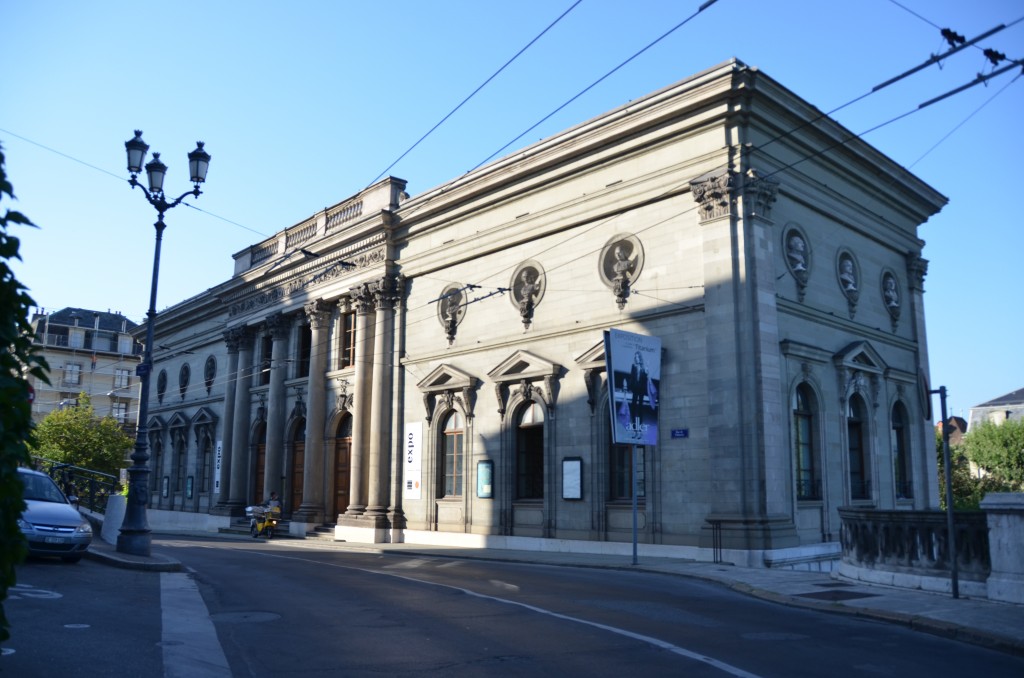
Located on the edge of the Old Town, just above Parc des Bastions, the Palais de l’Athénée is a historic 19th-century building that houses the Société des Arts. This institution serves as a hub for knowledge and culture offering a diverse annual program. The e Palais de l’Athénée’s Salle Crosnier regularly features inaugural solo exhibitions by young local artists, showcasing the work of four to five artists per year. The Salle Saint-Ours is dedicated to experimental curatorship, providing a platform for emerging curators to develop and present their projects. Additionally, the Palais de l’Athénée occasionally hosts concerts as well as conferences covering a diverse range of subjects.
Niels Hung, a graduate of HEAD–Genève, investigates his multicultural identity through painting shaped by American and Asian visual cultures. His works—repainted canvases and mixed-format paintings—often reappropriate images found online and in the street, interrogating contemporary image production and its slipperiness. Employing layered pictorial strategies and referential iconography, Hung stages a critical dialogue that oscillates between fascination and critique. He also joined the Work.Master teaching team in 2024 and engages with questions of artistic production and the artist’s condition.
Leila Asloun, Co-CEO of Groupe Serbeco and founder of ProP SA, brings expertise in waste management and recycling policy in Switzerland.
This lecture examines Switzerland’s pioneering recycling history and current sector pressures, including rising costs, declining material quality and the closure of local glassworks that forces longer transport. Asloun examines environmental and economic impacts, the role of exports and greenwashing, and explores emerging options for sustaining effective recycling systems.
In French.
Géraldine Veyrat, art historian and expert for the Service of the Inventory of Art and Historical Monuments (OPS), specialises in postwar public art and architectural interventions.
This lecture examines Geneva’s artistic ceramics from the 1950s, exploring how ceramists of the Geneva School engaged architecture, challenged ornamental categorisation, and elevated ceramics as an art form. It analyses the role of procurement policies allocating a percentage of construction costs, the inventive techniques used, and the works’ contribution to urban aesthetics.
In French.
Event removed from your CoolAgenda.
Your password has been reset successfully. You can now log in with your new password.
We’ve sent you a password reset email to the address provided. Please check your inbox and/or spam folder.
Please check your inbox for a verification email to complete your sign-up.