Wednesday 20 May, 15:00

Smartphone Disassembly Workshop

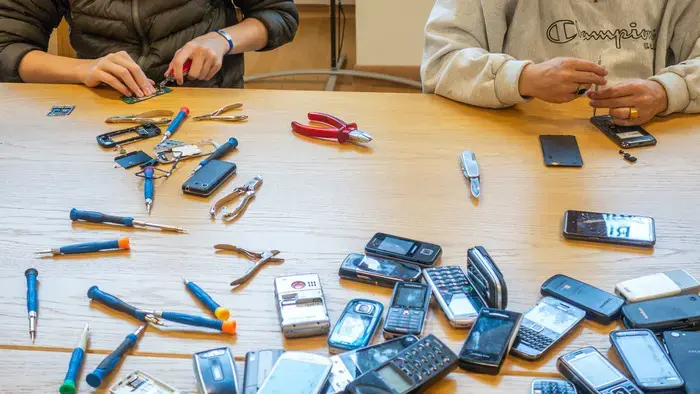
NoOPS leads this first « tech‑nostalgique » workshop, bringing a practical approach to smartphone dismantling and component recovery within the series.

Participants manually disassemble phones to identify secondary materials and pathways for recycling, learning how careful, fine disassembly preserves valuable components. Selected parts will be kept for use in later Tech‑Nostalgie workshops, linking material recovery to creative reuse.

In French.
Place des Trois-Perdrix 5,
1204 Genève
{"title":"Smartphone Disassembly Workshop","description":"\u003Cp\u003ENoOPS leads this first \u00ab tech\u2011nostalgique \u00bb workshop, bringing a practical approach to smartphone dismantling and component recovery within the series.\u003C\/p\u003E\u003Cp\u003EParticipants manually disassemble phones to identify secondary materials and pathways for recycling, learning how careful, fine disassembly preserves valuable components. Selected parts will be kept for use in later Tech\u2011Nostalgie workshops, linking material recovery to creative reuse.\u003C\/p\u003E\u003Cp\u003E\u003Cstrong\u003EIn French.\u003C\/strong\u003E\u003C\/p\u003E","start_date":"2026-05-20","end_date":"2026-05-20","date":"Wednesday 20 May, 15:00","timings":[{"timing_start_date":"20260520T150000Z","timing_end_date":"20260520T163000Z"}]}
Photo Credit: Cassandre Poirier-Simon

You might also like

Wednesday 15 April, 10:15

This event explores verse craft in English literary history. It includes a lecture by Dr Sawyer, a Q&A session, and an interactive workshop where participants reflect on their work in relation to verse history and literary craft. Drawing on Middle English poetry, the session highlights both lasting innovations—like rhyme and Chaucer’s meter—and forgotten experiments. Open to anyone interested in literary craft across periods.

In English.

Wednesday 22 April, 18:15

This public lecture by historian Laurence Badel examines how women entered the field of official diplomacy and gained access to state responsibilities. It traces a long and complex process, from the informal influence of aristocratic women in diplomatic circles to the gradual professionalisation of women diplomats from the 1920s to the 1970s. The talk highlights the first appointments of women as heads of mission in the interwar period, often shaped by political and discretionary choices, as well as the broader role of international organisations in fostering the feminisation of diplomacy. It also considers the growing presence of women from African, Asian, and Latin American contexts in shaping international affairs during the 20th century.

In French.

17 – 18 April

This international conference at the University of Geneva reflects on thirty years of research into drawing and painting in 15th–16th-century France. It revisits the impact of key earlier scholarship, especially the 1993–94 exhibition Quand la peinture était dans les livres, and considers how the field has evolved since then. The event highlights new methodologies, recent discoveries, and changing perspectives on artistic practices, production contexts, and networks in Renaissance France.

Wednesday 15 April, 18:15

This public lecture by Jacques-David Ebguy explores the idea of the Bildungsroman (the coming-of-age novel) and its limits, questioning whether the genre can exist fully in its “ideal” form. It examines how literary narratives of formation negotiate tensions between individual development, social constraints, and narrative closure. Through a critical approach to modern and contemporary literature, the talk reflects on the structural impossibility or fragility of the classical model of the coming-of-age story.

In French.

Wednesday 15 April, 18:15

This academic meeting is a discussion of the volume The I.B. Tauris Handbook of the Late Ottoman Empire, bringing together scholars to examine recent historiographical developments in the late Ottoman period and its legacies. The book offers a wide-ranging synthesis of current research, covering political, social, and cultural transformations from the late Ottoman Empire through its post-imperial aftermath. The event focuses on how recent scholarship has reinterpreted key themes such as nationalism, violence, state formation, and imperial collapse, while also highlighting new interdisciplinary approaches to the study of the region.

In French and English.

Sunday 14 June, 19:30

Alberto Manguel, Argentine-Canadian writer, essayist and former director of the National Library of Argentina, is known for A History of Reading and Reader of Borges; his work examines reading, libraries and literary imagination.

He will discuss Borges’s biographical dimension and its links to his poetics, examining how reading shaped Borges’s creativity—from childhood encounters in his father’s library to his later practice of reading through others. The lecture explores themes of memory, translation, textual transformation and the reader’s role.

In French.

Oops! It seems there
are no events matching your selection!

Please adjust your criteria to see more results.

Add to Calendar

Select the date to be saved in your Google calendar.

calendar placeholder

Done!

Event removed from your CoolAgenda.

Yeah!

Event Saved to your CoolAgenda

Add to CoolAgenda

In your CoolAgenda

Reset password

Password was reset

Your password has been reset successfully. You can now log in with your new password.

Check your Inbox

We’ve sent you a password reset email to the address provided. Please check your inbox and/or spam folder.

Forgot your password?

Thank you!

Please check your inbox for a verification email to complete your sign-up.

Sign Up

Create your Account and Culture Up!